Filter by
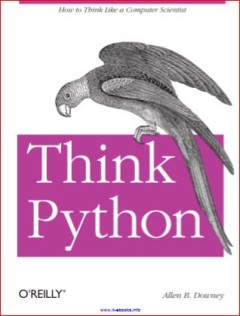
Think Python
The goal of this book is to teach you to think like a computer scientist. This way of thinking combines some of the best features of mathematics, engineering, and natural science. Like mathematicians, computer scientists use formal languages to denote ideas (specifically computations). Like engineers, they design things, assembling components into systems and evaluating tradeoffs among alternat…
- Edition
- -
- ISBN/ISSN
- 978-1-449-33072-9
- Collation
- 1-298
- Series Title
- -
- Call Number
- -
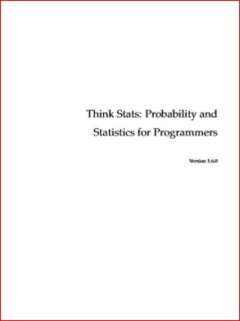
Think Stats: Probability and Statistics for Programmers
This book is about turning data into knowledge. Data is cheap (at least relatively); knowledge is harder to come by. I will present three related pieces: Probability is the study of random events. Most people have an intuitive understanding of degrees of probability, which is why you can use words like “probably” and “unlikely” without special training, but we will talk about how to m…
- Edition
- -
- ISBN/ISSN
- -
- Collation
- 1-140
- Series Title
- -
- Call Number
- -

Think Complexity
- Edition
- -
- ISBN/ISSN
- -
- Collation
- 1-148
- Series Title
- -
- Call Number
- -
- Edition
- -
- ISBN/ISSN
- -
- Collation
- 1-148
- Series Title
- -
- Call Number
- -
 Computer Science, Information & General Works
  Philosophy & Psychology
  Religion
  Social Sciences
  Language
  Pure Science
  Applied Sciences
  Art & Recreation
  Literature
  History & Geography