Filter by
Enterprise Risk Management Framework
EXECUTIVE SUMMARY Managements of some companies and other entities have developed processes to identify and manage risk across the enterprise, and many others have begun development or are considering doing so. While considerable information on enterprise risk management is available, including much published literature, no common terminology exists, and there are few if any widely accepted pr…
- Edition
- -
- ISBN/ISSN
- -
- Collation
- 1-152
- Series Title
- -
- Call Number
- -
Enterprise Risk Management – Integrated Framework
- Edition
- -
- ISBN/ISSN
- -
- Collation
- 1-113
- Series Title
- -
- Call Number
- -
- Edition
- -
- ISBN/ISSN
- -
- Collation
- 1-113
- Series Title
- -
- Call Number
- -
Strategic Management of Clinical Services
- Edition
- -
- ISBN/ISSN
- -
- Collation
- 1-14
- Series Title
- Strategic Management of Clinical Services
- Call Number
- -
- Edition
- -
- ISBN/ISSN
- -
- Collation
- 1-14
- Series Title
- Strategic Management of Clinical Services
- Call Number
- -
Enterprise Risk Management How Does ERM Apply to your Credit Union?
- Edition
- -
- ISBN/ISSN
- -
- Collation
- 1-60
- Series Title
- -
- Call Number
- -
- Edition
- -
- ISBN/ISSN
- -
- Collation
- 1-60
- Series Title
- -
- Call Number
- -
Software Risk Management A Practical Guide
This document is a practical guide for integrating software risk management into a software project. The purpose of Risk Management is to identify, assess and control project risks. Identified risks are analyzed to determine their potential impact and likelihood of occurrence. Risk Management Plans are developed to document the project’s approach to risk management, risks, and decisions made …
- Edition
- -
- ISBN/ISSN
- 0-201-25592-8
- Collation
- 1-31
- Series Title
- -
- Call Number
- -
Exploring the Mechanisms for Implementing a Risk Management Process:Overall A…
- Edition
- -
- ISBN/ISSN
- 1820 - 0222
- Collation
- 1-97
- Series Title
- -
- Call Number
- -
- Edition
- -
- ISBN/ISSN
- 1820 - 0222
- Collation
- 1-97
- Series Title
- -
- Call Number
- -
Controlling Costs and Changing Patient Care
With great speed and relatively little public awareness, a significant change has occurred in the way some decisions are made about a patient's medical care. Decisions that were once the exclusive province of the doctor and patient now may be examined in advance by an external reviewer—someone accountable to an employer, insurer, health maintenance organization (HMO), or other entity responsi…
- Edition
- -
- ISBN/ISSN
- 0-309-54309-6
- Collation
- 1-321
- Series Title
- -
- Call Number
- -
The Subjective Well-Being Module of the American Time Use Survey: Assessment …
- Edition
- -
- ISBN/ISSN
- ISBN 978-0-309-26661
- Collation
- -
- Series Title
- -
- Call Number
- -
- Edition
- -
- ISBN/ISSN
- ISBN 978-0-309-26661
- Collation
- -
- Series Title
- -
- Call Number
- -

A New Health System for the 21st Century
The American health care delivery system is in need of fundamental change. Many patients, doctors, nurses, and health care leaders are concerned that the care delivered is not, essentially, the care we should receive (Donelan et al., 1999; Reed and St. Peter, 1997; Shindul-Rothschild et al., 1996; Taylor, 2001). The frustration levels of both patients and clinicians have probably never been hi…
- Edition
- -
- ISBN/ISSN
- 978-0-309-07280-9
- Collation
- 1-360
- Series Title
- -
- Call Number
- -
Geotargeted Alerts and Warnings: Report of a Workshop on Current Knowledge an…
- Edition
- -
- ISBN/ISSN
- ISBN 978-0-309-28985
- Collation
- -
- Series Title
- -
- Call Number
- -
- Edition
- -
- ISBN/ISSN
- ISBN 978-0-309-28985
- Collation
- -
- Series Title
- -
- Call Number
- -
SBIR at the Department of Defense
- Edition
- -
- ISBN/ISSN
- ISBN 978-0-309-30656
- Collation
- -
- Series Title
- -
- Call Number
- -
- Edition
- -
- ISBN/ISSN
- ISBN 978-0-309-30656
- Collation
- -
- Series Title
- -
- Call Number
- -

Get Out of Your Mind & Into Your Life: The New Acceptance & Commitment Therapy
- Edition
- -
- ISBN/ISSN
- 978-1-57224-757-4
- Collation
- -
- Series Title
- Get Out of Your Mind & Into Your Life: The New Acceptance & Commitment Therapy
- Call Number
- -
- Edition
- -
- ISBN/ISSN
- 978-1-57224-757-4
- Collation
- -
- Series Title
- Get Out of Your Mind & Into Your Life: The New Acceptance & Commitment Therapy
- Call Number
- -
SBIR at the National Science Foundation
- Edition
- -
- ISBN/ISSN
- ISBN 978-0-309-31196
- Collation
- -
- Series Title
- -
- Call Number
- -
- Edition
- -
- ISBN/ISSN
- ISBN 978-0-309-31196
- Collation
- -
- Series Title
- -
- Call Number
- -
Industrialization of Biology: A Roadmap to Accelerate the Advanced Manufactur…
- Edition
- -
- ISBN/ISSN
- ISBN 978-0-309-31652
- Collation
- -
- Series Title
- -
- Call Number
- -
- Edition
- -
- ISBN/ISSN
- ISBN 978-0-309-31652
- Collation
- -
- Series Title
- -
- Call Number
- -

SBIR/STTR at the National Institutes of Health
- Edition
- -
- ISBN/ISSN
- ISBN 978-0-309-37877
- Collation
- -
- Series Title
- -
- Call Number
- -
- Edition
- -
- ISBN/ISSN
- ISBN 978-0-309-37877
- Collation
- -
- Series Title
- -
- Call Number
- -
STTR: An Assessment of the Small Business Technology Transfer Program
- Edition
- -
- ISBN/ISSN
- ISBN 978-0-309-37961
- Collation
- -
- Series Title
- -
- Call Number
- -
- Edition
- -
- ISBN/ISSN
- ISBN 978-0-309-37961
- Collation
- -
- Series Title
- -
- Call Number
- -

Economic Development
Economic Development, Eleventh Edition, presents the latest thinking in economic development with the clear and comprehensive approach that has been so well received in both the developed and developing worlds. The pace and scope of economic development continues its rapid, uneven, and sometimes unexpected evolution. This text explains the unprecedented progress that has been made in many …
- Edition
- 11th Edition
- ISBN/ISSN
- 978-0-13-801388-2
- Collation
- 1-829
- Series Title
- Economic Development
- Call Number
- -
The Legal Environment and Business Law
In a nation, the law can serve to (1) keep the peace, (2) maintain the status quo, (3) preserve individual rights, (4) protect minorities against majorities, (5) promote social justice, and (6) provide for orderly social change. Some legal systems serve these purposes better than others. Although a nation ruled by an authoritarian government may keep the peace and maintain the status quo, i…
- Edition
- 1st Edition
- ISBN/ISSN
- -
- Collation
- -
- Series Title
- The Legal Environment and Business Law
- Call Number
- -

Assessing Network Security
- Edition
- -
- ISBN/ISSN
- 0-7356-2033-4
- Collation
- -
- Series Title
- Assessing Network Security
- Call Number
- -
- Edition
- -
- ISBN/ISSN
- 0-7356-2033-4
- Collation
- -
- Series Title
- Assessing Network Security
- Call Number
- -

Diplomacy for the 21st Century: Embedding a Culture of Science and Technolog…
The mission of the Department of State (department) is to shape and sustain a peaceful, prosperous, just, and democratic world and foster conditions for stability and progress for the benefit of the American people and people everywhere. The strategy calls for the department to become more efficient, accountable, and effective in a world in which rising powers, growing instability, and technolo…
- Edition
- -
- ISBN/ISSN
- 978-0-309-37313-5
- Collation
- 1-191
- Series Title
- -
- Call Number
- -
Summary of a Workshop on Information Technology Research for Federal Statistics
- Edition
- -
- ISBN/ISSN
- 0-309-51479-7
- Collation
- 1-68
- Series Title
- -
- Call Number
- -
- Edition
- -
- ISBN/ISSN
- 0-309-51479-7
- Collation
- 1-68
- Series Title
- -
- Call Number
- -
Science and Technology Capabilities of the Department of State: Letter Report
The project that is the subject of this report was approved by the Governing Board of the National Research Council, whose members are drawn from the councils of the National Academy of Sciences, the National Academy of Engineering, and the Institute of Medicine. The members of the committee responsible for the report were chosen for their special competences and with regard for appropriate ba…
- Edition
- -
- ISBN/ISSN
- 978-0-309-30389-7
- Collation
- 1-9
- Series Title
- -
- Call Number
- -
A Constrained Space Exploration Technology Program: A Review of NASA's Explor…
In January 2004, President George W. Bush announced new elements of the nation’s space policy by issuing the Vision for Space Exploration (VSE),1 which instructed NASA to “extend human presence across the solar system, starting with a human return to the Moon by the year 2020, in preparation for human exploration of Mars and other destinations.” NASA was also directed to “develop the in…
- Edition
- -
- ISBN/ISSN
- 0-309-12584-7
- Collation
- 1-155
- Series Title
- -
- Call Number
- -
Improving NASA's Technology for Space Science
The continued advance of the nation's space program is directly dependent upon the development and use of new technology. Technology is the foundation for every aspect of space missions and ground operations. The improvements in technology that will enable future advances are not only in device and system performance, but also in permitting missions to be carried out more rapidly and at lower c…
- Edition
- -
- ISBN/ISSN
- 0-309-12264-3
- Collation
- 1-104
- Series Title
- -
- Call Number
- -
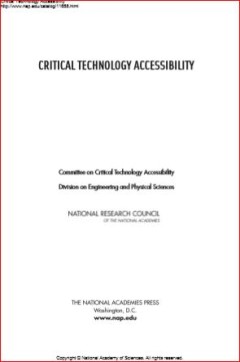
Critical Technology Accessibility
This report has been reviewed in draft form by individuals chosen for their diverse perspectives and technical expertise, in accordance with procedures approved by the National Research Council’s Report Review Committee. The purpose of this independent review is to provide candid and critical comments that will assist the institution in making its published report as sound as possible and to …
- Edition
- -
- ISBN/ISSN
- 0-309-65853-5
- Collation
- 1-73
- Series Title
- -
- Call Number
- -
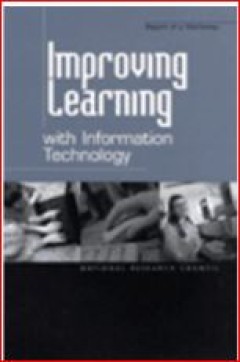
Improving Learning with Information Technology: Report of a Workshop
Handheld computers or personal digital assistants (PDAs) were launched in the marketplace in 1996. Within 18 months, these handheld devices had swept through the business community and virtually trans- formed the way people took notes and kept professional and personal cal- endars. Today, PDAs can connect to the Internet and provide a variety of services, from scouting out restaurants in the vi…
- Edition
- -
- ISBN/ISSN
- 0-309-50485-6
- Collation
- 1-85
- Series Title
- -
- Call Number
- -
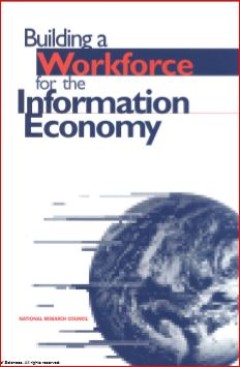
Building a Workforce for the Information Economy
More importantly, the committee has tried in this report to provide a way of thinking about workforce issues in IT/HT that is largely indepen- dent of specific legislation. It seems safe to predict that the debate over the IT/HT workforce and immigration will not be definitively resolved by any one piece of legislation—such is the nature of controversial issues engaged by the political proce…
- Edition
- -
- ISBN/ISSN
- 0-309-50518-6
- Collation
- 1-400
- Series Title
- -
- Call Number
- -

Funding a Revolution: Government Support for Computing Research
Computing technology is widely touted as fast moving. Generations of products and their underlying electronics are introduced at intervals of 18 to 24 months, and the number and variety of computer- and communications-based goods and services are growing. Technology and industry experts believe that the double-digit rates of improvement experienced in the last couple of decades can be sustain…
- Edition
- -
- ISBN/ISSN
- 0-309-52501-2
- Collation
- 300
- Series Title
- -
- Call Number
- -
Careers in Science and Technology: An International Perspective
As we approach the start of a new century, it is apparent that science and technology (S&T) will continue to play a pivotal role in modern life. Skilled workers will be needed at all levels. Many of these workers will be drawn from the pool of students presently passing through school systems around the world; the remainder represent workers already employed who will need to maintain their tech…
- Edition
- -
- ISBN/ISSN
- 0-309-56103-5
- Collation
- 1-195
- Series Title
- -
- Call Number
- -
Realizing the Information Future: The Internet and Beyond
The Computer Science and Telecommunications Board convened a study committee for this project that chose to call itself NRENAISSANCE, reflecting the fundamental concern with the NREN program and the challenge of meeting research, education, and library community needs in a context marked by much broader information infrastructure concerns. Many of the authors of the 1988 CSTB report are among t…
- Edition
- -
- ISBN/ISSN
- 0-309-58662-3
- Collation
- 1-320
- Series Title
- -
- Call Number
- -
 Computer Science, Information & General Works
  Philosophy & Psychology
  Religion
  Social Sciences
  Language
  Pure Science
  Applied Sciences
  Art & Recreation
  Literature
  History & Geography