Management
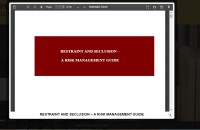
RESTRAINT AND SECLUSION – A RISK MANAGEMENT GUIDE
Courts have long recognized that people with mental illnesses have the right to be free from the improper use of seclusion and restraint. In the landmark 1982 case Youngberg v. Romeo, the Supreme Court recognized that the use of restraint is a drastic deprivation of personal liberty, holding that “[t]he right to be free from undue bodily restraint is the core of the liberty interest protected by the Due Process Clause from arbitrary governmental action.” Youngberg v. Romeo, 457 U.S. 307, 316 (1982).
In that case, the Supreme Court noted that the use of restraint should reflect “the exercise of professional judgment.” At the time of the Youngberg decision, restraint and seclusion were often used to control the behavior of people with mental health conditions in a variety of settings, and a broad range of views regarding what constitutes “professional judgment” existed among clinicians.
Over the past decade, however, a clear consensus has emerged that restraint and seclusion are safety interventions of last resort and that the use of these interventions can and should be reduced significantly. In evaluating the potential legal risks associated with the use of restraint and seclusion, risk managers should understand this emerging consensus as critical to a determination about whether a particular use of these interventions reflects “the exercise of professional judgment.” This should be considered in the context of the following factors:
(1) Each use of restraint or seclusion poses an inherent danger, both physical and psychological, to the individual who is subject to the interventions and, frequently, to the staff who administer them.
(2) The decision to use restraint or seclusion nearly always is arbitrary, idiosyncratic, and generally avoidable.
(3) Many inexpensive and effective alternatives to restraint and seclusion have been developed and successfully implemented across a broad range of mental health facility types.
Recent increased scrutiny regarding the use of restraint and seclusion has resulted in a legal and regulatory environment that discourages their use and increases the risks of litigation for clinicians and facilities that rely on these practices. The legal consequences of inappropriate use of restraint and seclusion can include civil damages, administrative sanctions (including the loss of Medicaid and Medicare certification), and criminal prosecution. Moreover, litigation about these practices invariably consumes the facility’s attention and resources, no matter what the ultimate outcome, with significant negative implications for the facility’s reputation and staff morale.
i
To minimize these risks, all mental health facilities should develop a risk management strategy that includes the following components:
(1) Review your facility’s current policies and practices regarding restraint and seclusion;
(2) Advise top management that legal exposure is increasing and that reducing the use of restraint and seclusion demands their attention;
(3) Establish a facility-wide task force including top management, staff, union representatives, and consumers to develop a plan to reduce restraint and seclusion that includes a public commitment to the goal of reduction, a strategy for workforce training, and the use of data to set outcomes targets and evaluate progress; and
(4) Maintain the priority of constant reduction in the use and duration of restraint and seclusion.
Availability
No copy data
Detail Information
- Series Title
-
-
- Call Number
-
-
- Publisher
- : .,
- Collation
-
1-35
- Language
-
English
- ISBN/ISSN
-
-
- Classification
-
NONE
- Content Type
-
-
- Media Type
-
-
- Carrier Type
-
-
- Edition
-
-
- Subject(s)
-
-
- Specific Detail Info
-
-
- Statement of Responsibility
-
-
Other version/related
No other version available
File Attachment
Comments
You must be logged in to post a comment
 Computer Science, Information & General Works
  Philosophy & Psychology
  Religion
  Social Sciences
  Language
  Pure Science
  Applied Sciences
  Art & Recreation
  Literature
  History & Geography