Mathematics
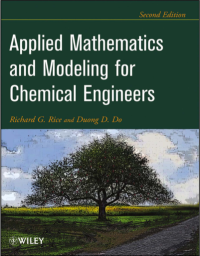
APPLIED MATHEMATICS AND MODELING FOR CHEMICAL ENGINEERS
While classical mathematics has hardly changed over the years, new applications arise regularly. In the second edition, we attempt to teach applicable mathematics to a new generation of readers involved in self-study and traditional university coursework. As in the first edition, we lead the reader through homework problems, providing answers while coaxing students to think more deeply about how the answer was uncovered. New material has been added, especially homework problems in the biochemical area, including diffusion in skin and brain implant drug delivery, and modern topics such as carbon dioxide storage, chemical reactions in nanotubes, dissolution of pills and pharmaceutical capsules, honeycomb reactors used in catalytic converters, and new models of important physical phenomenon such as bubble coalescence.
The presentation of linear algebra using vectors and matrices has been moved from an Appendix and interspersed between Chapters 1 and 2, and used in a number of places in the book, notably Chapters 11 and 12, where MATLAB referenced solutions are provided.
The model building stage in Chapter 1 has thus been augmented to include models with many variables using vectors and matrices. Chapter 2 begins teaching applied mathematics for solving ordinary differential equations, both linear and nonlinear. The chapter culminates with teaching how to solve arrays of coupled linear equations using matrix methods and the analysis of the eigen problem, leading to eigenvalues and eigenvectors. Classical methods for solving second-order linear equations with non constant coefficients are treated using series solutions via the method of Frobenius in Chapter 3. Special functions are also inspected, especially Bessel’s functions, which arise frequently in chemical engineering owing to our propensity toward cylindrical geometry. Integral functions, often
ignored in other textbooks, are given a careful review in Chapter 4, with special attention to the widely used error function. In Chapter 5, we study the mathematics of staged processing, common in chemical engineering unit opera- tions, and develop the calculus of finite difference equa- tions, showing how to obtain analytical solutions for both linear and nonlinear systems. This chapter adds a new homework problem dealing with economics and finite dif- ference equations used by central banks to forecast personal consumption. These five chapters would provide a suitable undergraduate course for third or fourth year students. To guide the teacher, we again have used a scheme to indicate homework problem challenges: subscripts 1 denotes mainly computational or setup problems, while subscripts 2 and 3 require more synthesis and analysis. Problems with an asterisk are the most difficult and are more suited for gradu- ate students.
The approximate technique for solving equations, especially nonlinear types, is treated in Chapter 6 using perturbation methods. It culminates with teaching the method of matched asymptotic expansion. Following this, other approximate methods suitable for computer implementation are treated in Chapter 7 as numerical solution by finite differences, for initial value problems. In Chapter 8, computer- oriented boundary value problems are addressed using weighted residuals and the methods of orthogonal collocation. Complex variables and Laplace transforms are given a combined treatment in Chapter 9, illustrating the intimate connection to the Fourier–Mellon complex integral, which is the basis for the Laplace transform.
Treatment of partial differential equations (PDEs) begins in Chapter 10, where classical methods are taught, including the combination of variables approach, the separation of variables method and the important orthogonality conditions arising from the SturmLiouville equation, and finally, solutions using Laplace transforms and the method of residues. After these classical methods, we introduce finite transform methods in Chapter 11, and exploit the othogonality condition to introduce a universal transform called the SturmLiouville transform. This method pro- duces as subsets the famous Hankel and Fourier transforms. The concept of Hilbert space is explained and the solution of coupled partial differential equations is illustrated using the famous batch adsorber problem. The last chapter (12) of the book deals with approximate and numerical solution methods for PDE, treating polynomial approximation, singular perturbation, and finite difference methods. Orthogonal collocation methods applied to PDEs are given an extensive treatment. Appendices provide useful information on numerical methods to solve algebraic equations and a careful explanation of numerical integration algorithms.
After 17 years in print, we would be remiss by not mentioning the many contributions and suggestions by users
and teachers from around the world. We especially wish to thank Professor Dean O. Harper of the University of Louisville and his students who forwarded errata that proved most helpful in revision for the second edition. Thanks also to Professor Morton M. Denn of CCNY for suggesting the transfer from the Appendix of vectors and matrix methods to the first two chapters. Reviewers who have used the book also gave many good ideas for revision in the second edition, and we wish to thank colleagues from Bucknell University, notably Professors James E. Maneval and William E. King. We continue to be grateful to students and colleagues who point out errors, typos, and suggestions for additional material; we particularly appreciate the help of Professor Benjamin J. McCoy of UC Davis and Ralph E. White of the University of South Carolina. In the final analysis, any remaining errors, and the selection of material to include, are the responsibility of the authors, and we apologize for not including all the changes and additions suggested by others.
Availability
No copy data
Detail Information
- Series Title
-
-
- Call Number
-
-
- Publisher
- : ., 2012
- Collation
-
-
- Language
-
English
- ISBN/ISSN
-
978-1-118-02472-9
- Classification
-
NONE
- Content Type
-
-
- Media Type
-
-
- Carrier Type
-
-
- Edition
-
Second Edition
- Subject(s)
-
-
- Specific Detail Info
-
-
- Statement of Responsibility
-
-
Other version/related
No other version available
File Attachment
Comments
You must be logged in to post a comment
 Computer Science, Information & General Works
  Philosophy & Psychology
  Religion
  Social Sciences
  Language
  Pure Science
  Applied Sciences
  Art & Recreation
  Literature
  History & Geography