Mathematics
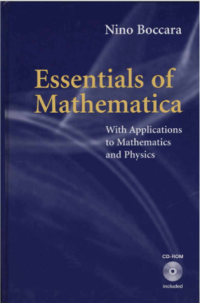
Essentials of Mathematica
This book consists of two parts. Part I describes the essential Mathematica commands illustrated with many examples and Part II presents a variety of applications to mathematics and physics showing how Mathematica could be systematically used to teach these two disciplines.
The book is based on an introductory course taught at the University of Illinois at Chicago to advanced undergraduate and graduate students of the physics department who were not supposed to have any prior knowledge of Mathematica.
Mathematica is a huge mathematical software developed by Wolfram Research Inc. It is an interactive high-level programming language that has all the mathematics one is likely to need already built-in. Moreover, its interactivity allows testing built-in and user-defined functions without difficulty thanks to numerical, symbolic and graphic capabilities. All these features should en- courage students to look at a problem in a computational way, and discover the many benefits of this manner of thinking. For instance, when studying a new problem, Mathematica makes it easy to test many examples that might reveal unsuspected patterns.
The reader is advised to first study Chapter 1 of Part I entitled A Panorama of Mathematica which presents an overview of the most frequently used com- mands. The following chapters—dealing with Numbers, Algebra, Analysis, Lists, Graphics, Statistics and Programming—go into more details. The reader would probably make the most of the book browsing, as soon as possible, Part II, devoted to Applications to Mathematics and Physics, coming back to Part I to go deeper into specific commands and their various options.
This book is intended for beginners who want to be able to write a small efficient Mathematica program in order to solve a given problem. Having this in mind, we made every effort to follow the same technique: first the problem is broken up into its different component parts, then each part of the problem is solved using either a built-in or a user-defined Mathematica function, checking carefully that this function does exactly what it was supposed to do, and the program is finally built up by grouping together all these functions using a standard structure.
Note concerning the figures
Most figures have been generated using colors as indicated by their Mathematica code but are represented in the book using only various shades of grey. However all the figures can be found in color in the accompanying CD-ROM which also contains all the Mathematica cells that appear in the book.
Availability
No copy data
Detail Information
- Series Title
-
-
- Call Number
-
-
- Publisher
- : .,
- Collation
-
-
- Language
-
English
- ISBN/ISSN
-
978-0-387-49514-9
- Classification
-
NONE
- Content Type
-
-
- Media Type
-
-
- Carrier Type
-
-
- Edition
-
-
- Subject(s)
-
-
- Specific Detail Info
-
-
- Statement of Responsibility
-
-
Other version/related
No other version available
File Attachment
Comments
You must be logged in to post a comment
 Computer Science, Information & General Works
  Philosophy & Psychology
  Religion
  Social Sciences
  Language
  Pure Science
  Applied Sciences
  Art & Recreation
  Literature
  History & Geography