Information Technology
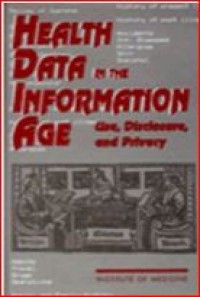
Health Data in the Information Age: Use, Disclosure, and Privacy
From the very first meetings, in the early 1970s, of the newly constituted Institute of Medicine (IOM) of the National Academy of Sciences, a major objective has been the engagement of the most important and difficult health and science policy issues from the public's or society's perspective. The Institute was created so that a broad-based and multidisciplinary membership could work across professions, within and without the health sciences, toward the solution of these complex and difficult problems. From my personal experience as a staff member at the IOM during the first four years of its life, I can attest to the early recognition of the importance of the process of having a balanced, multidisciplinary committee working on the policy issues at hand. The assumption was that the sum of the parts of such a diverse group was surpassed by the synergy of the whole; more often than not, this positive learning experience also produced a useful document or report. In my personal experience with such groups, I cannot recall a failure either in the product and its value or in the process and its impact on the individuals participating. I must say, however, that the challenges facing this committee on regional databases were so great and our initial difficulties so intense in becoming clear about and comfortable with the seminal questions embedded in our charge that I was not optimistic about either our two-year experience together or the product that I could envision emerging.
Availability
No copy data
Detail Information
- Series Title
-
-
- Call Number
-
-
- Publisher
- : ., 1994
- Collation
-
1-272
- Language
-
English
- ISBN/ISSN
-
0-309-53821-1
- Classification
-
NONE
- Content Type
-
-
- Media Type
-
-
- Carrier Type
-
-
- Edition
-
-
- Subject(s)
- Specific Detail Info
-
-
- Statement of Responsibility
-
-
Other version/related
No other version available
File Attachment
Comments
You must be logged in to post a comment
 Computer Science, Information & General Works
  Philosophy & Psychology
  Religion
  Social Sciences
  Language
  Pure Science
  Applied Sciences
  Art & Recreation
  Literature
  History & Geography