Management
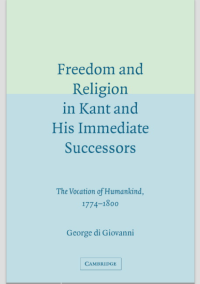
Freedom and Religion in Kant and His Immediate Successors
Kant is the most important figure in this book, as one would expect in a work that deals with late-eighteenth-century German philosophy. He is not, however, the only or even its main object of interest. As a matter of fact, Fichte will end up occupying just as much space as Kant. The main object of interest lies, however, in neither of these two philosophers but at the intersection of two themes too broad to consider on their own. One has to do with the reception of Kant between the publication of the Critique of Pure Reason in 1781 and Fichte’s publication of The Vocation of Humankind in 1800 – in the period, that is, when transcendental idealism was being transformed either into what eventually came to be known as ‘post-Kantian idealism’ or into that kind of typically German form of scientific as well as religious positivism that took hold of the German philosophy faculties in the nineteenth century. The philosophy of Jakob Friedrich Fries can be cited as a splendid example of this kind of positivism.1 The other theme has to do with the revolution in the traditional conception of ‘humanity’ that had been underway throughout Europe long before the publication of Kant’s Critique. Such a revolution was radical in nature and inevitably posed some formidable challenges to the still deeply religious culture of the late German Enlightenment. The object of this book is to show, on the one hand, how Kant’s Critique of Reason2 was itself part of this revolution, and, on the other hand, how older modes of thought interfered with a proper understanding of its conceptual as well as cultural implications. The fact that Kant himself was not completely clear about such implications, but remained in many respects still hostage to the philosophical language of the older tradition, made things all the worse.
Availability
No copy data
Detail Information
- Series Title
-
Freedom and Religion in Kant and His Immediate Successors
- Call Number
-
-
- Publisher
- USA : ., 2005
- Collation
-
1-391
- Language
-
English
- ISBN/ISSN
-
-
- Classification
-
NONE
- Content Type
-
-
- Media Type
-
-
- Carrier Type
-
-
- Edition
-
1st Edtion
- Subject(s)
- Specific Detail Info
-
-
- Statement of Responsibility
-
-
Other version/related
No other version available
File Attachment
Comments
You must be logged in to post a comment
 Computer Science, Information & General Works
  Philosophy & Psychology
  Religion
  Social Sciences
  Language
  Pure Science
  Applied Sciences
  Art & Recreation
  Literature
  History & Geography