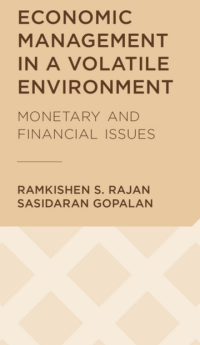
Management
Economic Management in a Volatile Environment
Since the 1990s, several developing economies have, to varying degrees, embraced “financial globalisation”, broadly defined as a set of poli- cies that involve allowing for greater openness to cross-border capital flows as well as greater market access to foreign financial institutions. Developing economies that have become increasingly dependent on and able to attract foreign private savings to supplement domestic savings (as opposed to official lending from the regional and international finan- cial institutions) are loosely referred to as “emerging market economies” (EMEs). There is no definite criterion that identifies or qualifies a set of countries as EMEs.1 The International Monetary Fund (IMF) for instance lists 150 countries from various regions as “emerging and developing economies” although it refers to and uses different subsets of this list of countries as EMEs.2
In recognition that the term EMEs is too broad and all-encompassing, a number of innovative sub-groupings have subsequently been devel- oped. For instance, “BRIC” was one such grouping of EMEs popularised by Goldman Sachs (2001), referring to Brazil, Russia, India, and China.3 The BRICs, consisting of fast growing large developing economies, were projected by Goldman Sachs to possess the potential to be the most dynamic set of economies in the world by 2050, eclipsing the advanced economies in terms of economic growth. Another notable group of EMEs that has gained prominence due to their rapid growth and aggre- gate size are Bangladesh, Egypt, Indonesia, Iran, Korea, Mexico, Nigeria, Pakistan, Philippines, Turkey, and Vietnam. These economies have been lumped together as the Next-11 (N-11), so identified by Goldman Sachs (2007) as potential high-growth economies complementing the BRICs “that could potentially have a BRIC-like impact in rivalling the G7” (p. 2).4 The report also adds that the N-11 is “unlikely to rival the BRICs as a grouping in scale, but N-11 GDP could reach two-thirds the size of the G7 by 2050” (p. 4).
Availability
No copy data
Detail Information
- Series Title
-
Economic Management in a Volatile Environment
- Call Number
-
-
- Publisher
- USA : Palgrave Macmillan., 2015
- Collation
-
1-305
- Language
-
English
- ISBN/ISSN
-
978–1–137–37151–5
- Classification
-
NONE
- Content Type
-
-
- Media Type
-
-
- Carrier Type
-
-
- Edition
-
1st Edtion
- Subject(s)
- Specific Detail Info
-
-
- Statement of Responsibility
-
-
Other version/related
No other version available
File Attachment
Comments
You must be logged in to post a comment
 Computer Science, Information & General Works
  Philosophy & Psychology
  Religion
  Social Sciences
  Language
  Pure Science
  Applied Sciences
  Art & Recreation
  Literature
  History & Geography