Law
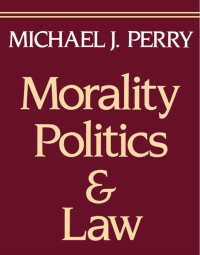
MORALITY, POLITICS, AND LAW
Several years ago I wrote a book about the proper role of the judiciary— particularly the federal judiciary, and especially the Supreme Court of the United States—in adjudicating constitutional issues.1 In that book I assumed that there can be right answers—and wrong ones, too—to questions of morality. (I was concerned principally with questions of political morality. I argued thatjudges should play a relatively large role in the effort to locate the right answers to constitutional questions, understood as an important species of questions of political morality.) That assumption was—and remains—controversial, however, and so I decided to put the assumption in question.
I began this book as an effort to understand and then to address the problem of whether answers to moral questions have truth value— whether moral claims can bear the predicate true/false or any equivalent predicate, such as rationally acceptable/unacceptable. In the course of writing this book my inquiry broadened. Although I do address here the problem of right answers to moral questions, my fundamental subject is the proper relation of moral beliefs—including moral beliefs religious in character—to politics and law, especially constitutional law, in a morally pluralistic society.
The moral culture of the United States is pluralistic: American society comprises many different moral communities, including religious com- munities.2 Some observers think that this state of affairs makes the United States a City of Babel3—that productive moral discourse among all or even most of the various moral communities is impossible to achieve because the basic moral beliefs of many communities are fundamentally different from those of many others.4 Even if it does not make the United States a City of Babel, the pluralistic character of American moral culture gives rise to a number of serious problems concerning the relation of morality and religion to politics and law, which it is the aim of this book to address
Availability
No copy data
Detail Information
- Series Title
-
MORALITY, POLITICS, AND LAW
- Call Number
-
-
- Publisher
- New York : Oxford University Press., 1988
- Collation
-
1-336
- Language
-
English
- ISBN/ISSN
-
0-19-505296-X
- Classification
-
NONE
- Content Type
-
-
- Media Type
-
-
- Carrier Type
-
-
- Edition
-
1st Edtion
- Subject(s)
- Specific Detail Info
-
-
- Statement of Responsibility
-
-
Other version/related
No other version available
File Attachment
Comments
You must be logged in to post a comment
 Computer Science, Information & General Works
  Philosophy & Psychology
  Religion
  Social Sciences
  Language
  Pure Science
  Applied Sciences
  Art & Recreation
  Literature
  History & Geography