Management
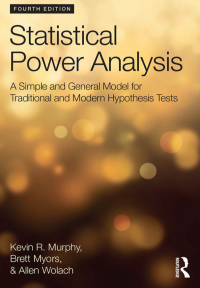
STATISTICAL POWER ANALYSIS
In the social and behavioral sciences, statistics serve two general purposes. First, they can be used to describe what happened in a particular study (descriptive statistics). Second, they can be used to help draw conclu- sions about what those results mean in some broader context (inferential statistics). The main question in inferential statistics is whether a result, finding, or observation from a study reflects some meaningful phenomenon in the population from which that study was drawn. For example, if 100 college sophomores are surveyed and it is determined that a majority of them prefer pizza to hot dogs, does this mean that people in general (or college students in general) also prefer pizza? If a medical treatment yields improvements in 6 out of 10 patients, does this mean that it is an effective treatment that should be approved for general use? The goal of inferential statistics is to determine what sorts of inferences and generalizations can be made on the basis of data of this sort, and to assess the strength of evidence and the degree of confidence one can have in these inferences.
The process of drawing inferences about populations from samples is a risky one, and a great deal has been written about the causes and cures for errors in statistical inference. Statistical power analysis (Cohen, 1988; Kraemer & Thiemann, 1987; Lipsey, 1990) falls under this general heading. Studies with too little statistical power can lead to erroneous conclusions about the meaning of the results of a particular study. In the example cited above, the fact that a medical treatment worked for 6 out of 10 patients is probably insufficient evidence that it is truly safe and effective, and if you have nothing more than this study to rely on, you might conclude that the treatment has not been proven effective. Does this mean that you should abandon the treatment, or that it is unlikely to work in a broader population? The conclusion that the treatment has not been shown to be effective may say as much about the low level of statistical power in your study as it does about the value of the treatment.
Availability
No copy data
Detail Information
- Series Title
-
STATISTICAL POWER ANALYSIS
- Call Number
-
-
- Publisher
- USA : Taylor & Francis Inc.., 2014
- Collation
-
1-244
- Language
-
English
- ISBN/ISSN
-
978-1-315-77315-5
- Classification
-
NONE
- Content Type
-
-
- Media Type
-
-
- Carrier Type
-
-
- Edition
-
4th Edtion
- Subject(s)
- Specific Detail Info
-
-
- Statement of Responsibility
-
-
Other version/related
No other version available
File Attachment
Comments
You must be logged in to post a comment
 Computer Science, Information & General Works
  Philosophy & Psychology
  Religion
  Social Sciences
  Language
  Pure Science
  Applied Sciences
  Art & Recreation
  Literature
  History & Geography