Management
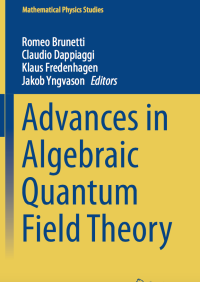
Advances in Algebraic Quantum Field Theory
Relativistic quantum field theory was conceived in the late 1920s as a framework unifying the two fundamental theories that revolutionized physics in the twentieth century: Quantum Mechanics and the Special Theory of Relativity. Algebraic Quantum Field Theory (AQFT) is relativistic quantum field theory regarded from a certain perspective, emphasizing localization of observables in space and time. It has its roots in the pioneering work of Rudolf Haag and Arthur Wightman from the 1950s and is a well-established branch of mathematical physics, distinguished by clear conceptual foundations and mathematically sound arguments.
AQFT is also called Local Quantum Physics which is the title of a monograph by Rudolf Haag1 that summarizes the results and insights achieved by many researchers up to the mid-1990s. Since then a number of new developments have taken place. In May 19–23, 2014 a workshop with the title “Algebraic quantum field theory: Its status and its future” was held at the Erwin Schrödinger Institute for Mathematical Physics (ESI) in Vienna. The present volume reflects many of the themes discussed at this workshop but all contributions were written specially for this volume. The first contribution, by Klaus Fredenhagen, is a general introduction to the fundamentals of AQFT while other chapters focus on more specialized topics. The chapter by Fredenhagen and Katarzyna Rejzner in particular, shows how perturbative constructions of models with interactions fit elegantly into the for- malism of AQFT.
One of the strengths of the algebraic approach is that it can be naturally applied when the underlying space-time manifold is curved, thus allowing to take important aspects of General Relativity into account. A large number of results on the characterization of physically important states, general covariance, perturbation theory, and renormalization, both on flat and curved space-times, have been obtained in the past 20 years and several of the contributions deal with these topic
Availability
No copy data
Detail Information
- Series Title
-
Advances in Algebraic Quantum Field Theory
- Call Number
-
-
- Publisher
- USA : ., 2015
- Collation
-
1-460
- Language
-
English
- ISBN/ISSN
-
978-3-319-21353-8
- Classification
-
NONE
- Content Type
-
-
- Media Type
-
-
- Carrier Type
-
-
- Edition
-
1st Edtion
- Subject(s)
- Specific Detail Info
-
-
- Statement of Responsibility
-
-
Other version/related
No other version available
File Attachment
Comments
You must be logged in to post a comment
 Computer Science, Information & General Works
  Philosophy & Psychology
  Religion
  Social Sciences
  Language
  Pure Science
  Applied Sciences
  Art & Recreation
  Literature
  History & Geography