Management
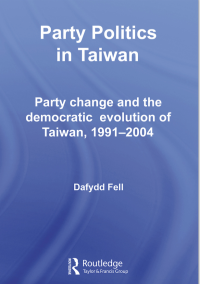
Party Politics in Taiwan
The year 2001 marked the tenth anniversary of Taiwan’s multi-party elections. The National Assembly elections of 1991 and the forced retirement of the senior parliamentarians elected in the 1940s on the Chinese mainland signify the begin- ning of democratic elections that for the first time had the potential to bring about a change in the ruling party. Ten years have passed, offering a timely opportunity to take stock of the developments in Taiwan’s party politics.
Being the only Chinese democracy, Taiwan is an important case study for party scholars. Many newer democracies have struggled to make the transition into liberal democracies with strong coherent political parties that offer the distinct policy platforms for voters to make an informed policy choice. Instead, these par- ties are often largely vehicles for ambitious politicians to gain office; this is well illustrated by the fluidity of party break-ups and mergers in South Korea and Japan in the 1990s.1 In contrast, Taiwan has consolidated its democracy faster than most other new democracies, and previous studies have shown Taiwan’s political parties to be comparatively institutionalized.2
When Taiwan held its first full democratic elections in the early 1990s the prospects for Taiwan’s democratic consolidation were still far from certain. Taiwan’s parties were highly polarized on the core election issues of the day, with all its inherent dangers for political instability. In the light of the ruling Kuomintang party’s (KMT      ) overwhelming election victory in 1991 and its huge financial and organizational advantages, Taiwan seemed destined to have a one party dominant system. However, ten years later Taiwan’s political cli- mate had radically changed. The one party dominant system has been replaced by a vibrant multi-party system with up to five significant political parties contesting elections. The opposition Democratic Progressive Party’s (DPP    ) success at setting the electoral agenda on its most favourable issues such as welfare, national identity and political corruption contributed to its increasing support rates and election successes. The DPP became the ruling party after winning the presiden- tial election in 2000, and the largest party in the Legislative Yuan a year later. Taiwan has developed a pattern of competitive party politics in which the major parties’ election platforms rapidly became institutionalized into a state of moderate differentiation though the parties have shifted towards more moderate positions, they have retained distinct policy-based identitie
Availability
No copy data
Detail Information
- Series Title
-
Party Politics in Taiwan
- Call Number
-
-
- Publisher
- USA : Routledge., 2005
- Collation
-
1-201
- Language
-
English
- ISBN/ISSN
-
0–415–35973–2
- Classification
-
NONE
- Content Type
-
-
- Media Type
-
-
- Carrier Type
-
-
- Edition
-
1st Edtion
- Subject(s)
-
-
- Specific Detail Info
-
-
- Statement of Responsibility
-
-
Other version/related
No other version available
File Attachment
Comments
You must be logged in to post a comment
 Computer Science, Information & General Works
  Philosophy & Psychology
  Religion
  Social Sciences
  Language
  Pure Science
  Applied Sciences
  Art & Recreation
  Literature
  History & Geography