Computer Science
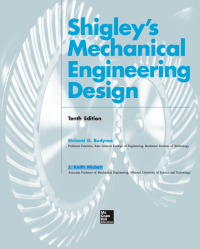
SHIGLEY’S MECHANICAL ENGINEERING DESIGN
Mechanical design is a complex process, requiring many skills. Extensive relation- ships need to be subdivided into a series of simple tasks. The complexity of the process requires a sequence in which ideas are introduced and iterated. We first address the nature of design in general, and then mechanical engineering design in particular. Design is an iterative process with many interactive phases. Many resources exist to support the designer, including many sources of information and an abundance of computational design tools. Design engineers need not only develop competence in their field but they must also cultivate a strong sense of responsibility and professional work ethic.
There are roles to be played by codes and standards, ever-present economics, safety, and considerations of product liability. The survival of a mechanical compo- nent is often related through stress and strength. Matters of uncertainty are ever- present in engineering design and are typically addressed by the design factor and factor of safety, either in the form of a deterministic (absolute) or statistical sense. The latter, statistical approach, deals with a design’s reliability and requires good statistical data.
In mechanical design, other considerations include dimensions and tolerances, units, and calculations. This book consists of four parts. Part 1, Basics, begins by explaining some dif- ferences between design and analysis and introducing some fundamental notions and approaches to design. It continues with three chapters reviewing material properties, stress analysis, and stiffness and deflection analysis, which are the principles neces- sary for the remainder of the book. Failure Prevention, consists of two chapters on the prevention of failure of mechanical parts. Why machine parts fail and how they can be designed to prevent failure are difficult questions, and so we take two chapters to answer them, one on preventing failure due to static loads, and the other on preventing fatigue failure due to time-varying, cyclic loads
Availability
No copy data
Detail Information
- Series Title
-
SHIGLEY’S MECHANICAL ENGINEERING DESIGN
- Call Number
-
-
- Publisher
- USA : McGraw-Hill Education., 2015
- Collation
-
1-1105
- Language
-
English
- ISBN/ISSN
-
978-0-07-339820-4
- Classification
-
NONE
- Content Type
-
-
- Media Type
-
-
- Carrier Type
-
-
- Edition
-
10th Edtion
- Subject(s)
- Specific Detail Info
-
-
- Statement of Responsibility
-
-
Other version/related
No other version available
File Attachment
Comments
You must be logged in to post a comment
 Computer Science, Information & General Works
  Philosophy & Psychology
  Religion
  Social Sciences
  Language
  Pure Science
  Applied Sciences
  Art & Recreation
  Literature
  History & Geography