Filter by
Foreign AffiliaTes Statistics (FATS) Recommendations Manual
The FATS manual is a milestone on the road to EU-wide harmonised Foreign AffiliaTes Statistics (FATS). Its importance becomes even more apparent when we consider the political background to this project. All over the world, ‘globalisation’ is seen as the predominant agent of change and the main policy challenge. At the heart of this complex and somewhat blurry concept, however, lie busi…
- Edition
- -
- ISBN/ISSN
- -
- Collation
- -
- Series Title
- -
- Call Number
- -

Foreign AffiliaTes Statistics (FATS)
- Edition
- -
- ISBN/ISSN
- -
- Collation
- -
- Series Title
- -
- Call Number
- -
- Edition
- -
- ISBN/ISSN
- -
- Collation
- -
- Series Title
- -
- Call Number
- -

Science, technology and innovation in Europe
This pocketbook gives an overview of science, technology and innovation (STI) statistics. All the statistical data and indicators are based on sources available at Eurostat. Only the most relevant indicators have been selected so as to give an overall statistical picture of science, technology and innovation in Europe and of how the EU stands in relation to its partners. Eurostat has been colle…
- Edition
- -
- ISBN/ISSN
- 1830-754X
- Collation
- 1-164
- Series Title
- -
- Call Number
- -
Summary Minutes of the Working Group (WG) Meeting "Harmonization of Consume…
The Econometric Study and Model to Estimate Land Prices undertaken by an external contractor on behalf of Eurostat showed that a separation of the land price part from the structure part was not feasible from the data at hand. Notwithstanding the traditional partition to land and structure becomes less clear depending on the allocation of the location variables. More conceptual work and a furth…
- Edition
- -
- ISBN/ISSN
- -
- Collation
- 1-3
- Series Title
- -
- Call Number
- -
Third quarter of 2007 EU27 current account deficit 17.2 bn euro 23.2 bn euro …
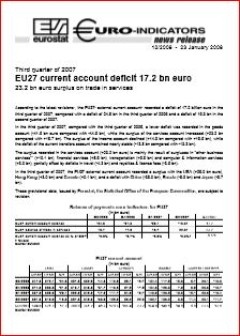
According to the latest revisions1, the EU272 external current account3 recorded a deficit of 17.2 billion euro in the third quarter of 2007, compared with a deficit of 24.6 bn in the third quarter of 2006 and a deficit of 16.3 bn in the second quarter of 2007. In the third quarter of 2007, compared with the third quarter of 2006, a lower deficit was recorded in the goods account (-41.5 bn eu…
- Edition
- -
- ISBN/ISSN
- -
- Collation
- 1-6
- Series Title
- -
- Call Number
- -
Second estimate for the second quarter of 2009 EU27 current account deficit 4…
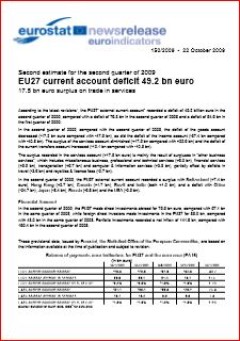
In the second quarter of 2009, compared with the second quarter of 2008, the deficit of the goods account decreased (-17.2 bn euro compared with -47.5 bn), as did the deficit of the income account (-37.4 bn compared with -40.8 bn). The surplus of the services account diminished (+17.5 bn compared with +22.6 bn) and the deficit of the current transfers account increased (-12.1 bn compared with -…
- Edition
- -
- ISBN/ISSN
- -
- Collation
- 1-5
- Series Title
- -
- Call Number
- -
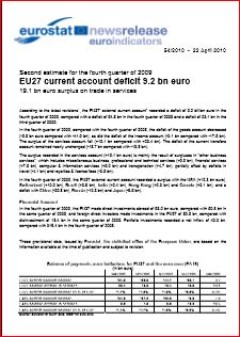
Second estimate for the fourth quarter of 2009 EU27 current account deficit 9…
According to the latest revisions1, the EU272 external current account3 recorded a deficit of 9.2 billion euro in the fourth quarter of 2009, compared with a deficit of 54.8 bn in the fourth quarter of 2008 and a deficit of 23.1 bn in the third quarter of 2009.
- Edition
- -
- ISBN/ISSN
- -
- Collation
- 1-5
- Series Title
- -
- Call Number
- -
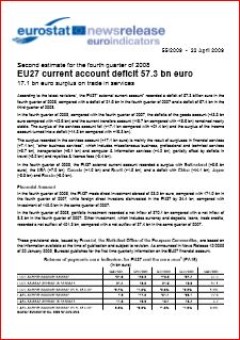
Second estimate for the fourth quarter of 2008 EU27 current account deficit 5…
According to the latest revisions1, the EU272 external current account3 recorded a deficit of 57.3 billion euro in the fourth quarter of 2008, compared with a deficit of 21.6 bn in the fourth quarter of 2007 and a deficit of 67.4 bn in the third quarter of 2008.
- Edition
- -
- ISBN/ISSN
- -
- Collation
- 1-5
- Series Title
- -
- Call Number
- -
First estimate for the fourth quarter of 2010 Euro area and EU27 employment u…
The number of persons employed in both the euro area1 (EA16) and the EU271 increased by 0.1% in the fourth quarter of 2010 compared with the previous quarter, according to national accounts estimates published by Eurostat, the statistical office of the European Union. In the third quarter of 2010, employment was stable in the euro area and grew in the EU27 by 0.1%. These figures are seasonally …
- Edition
- -
- ISBN/ISSN
- -
- Collation
- 1-4
- Series Title
- -
- Call Number
- -

International Trade in Services EU25 surplus in trade in services increased t…
In 2004, EU25 1 external trade in services 2 recorded a surplus of 42.8 billion euro, compared to 37.0 bn in 2003. This increased surplus was mainly due to a higher surplus in transportation (+13.4 bn in 2004 compared to +7.0 bn in 2003), while the deficit registered for travel was slightly lower (-12.9 bn compared to -13.4 bn). The surplus recorded for “other services” fell slightly (+42.5…
- Edition
- -
- ISBN/ISSN
- -
- Collation
- 1-3
- Series Title
- -
- Call Number
- -
International Trade in Services EU surplus down to almost €163 bn in 2014 T…
The main components of EU international trade in services were "other business services" (R&D, business, professional & technical services) which accounted in 2014 for 26% of EU total exports and 28% of imports, Transport services (18% and 20%), Travel services (14% and 16%), Telecommunications, computer and information services (12% and 9%) and Financial services (10% and 6%). In 2014, the…
- Edition
- -
- ISBN/ISSN
- -
- Collation
- 1-3
- Series Title
- -
- Call Number
- -

Science, technology, innovation and entrepreneurship: 2009, the year of creat…
Modern economies place increasing emphasis on adding value by means of better use of knowledge and innovation. Most analysts agree that education and training can be a determining factor in enhancing creativity, innovation performance and competitiveness – the ‘knowledge triangle’ comprising education, research and innovation. However, creativity and innovation are also linked to personal…
- Edition
- -
- ISBN/ISSN
- -
- Collation
- 1-44
- Series Title
- -
- Call Number
- -

The social situation in the European Union
The social situation is largely formed in the cross-field between longer-term developments in population structures and short to medium term changes in the economy. After five years of strong economic growth, which created 12 million jobs and raised the employment rate by four percentage points to 64.0% of the working age population, the outlook has now become less optimistic. In 2001 the rat…
- Edition
- -
- ISBN/ISSN
- -
- Collation
- 1-212
- Series Title
- -
- Call Number
- -

Manual on sources and methods for the compilation of esa 95 financial accounts
- Edition
- -
- ISBN/ISSN
- 978-92-79-19452-8
- Collation
- -
- Series Title
- -
- Call Number
- -
- Edition
- -
- ISBN/ISSN
- 978-92-79-19452-8
- Collation
- -
- Series Title
- -
- Call Number
- -
Manual on sources and methods for the compilation of COFOG Statistics Class…
GDP in many European countries, provides for public services and re-distributive flows, such as social benefits. There is an increasing interest in the purposes of government expenditure and the way in which these purposes change over time. The focus on the quality of public finances, work led in Europe by the Economic Policy Committee under the direction of the ECOFIN council, requires hi…
- Edition
- 2007 edition
- ISBN/ISSN
- 978-92-79-04762-6
- Collation
- -
- Series Title
- -
- Call Number
- -
Manual on sources and methods for quarterly financial accounts for general g…
I am pleased to present this new manual on Quarterly Financial Accounts for the General Government. Given the high user interest accorded to government finance statistics, the introduction of the compilation and collection of timely quarterly financial data has been welcomed. These data complement quarterly data collected for the non-financial transactions of government, in a harmonised wa…
- Edition
- -
- ISBN/ISSN
- -
- Collation
- -
- Series Title
- -
- Call Number
- -
Quality report on balance of payments, international trade in services and f…
- Edition
- -
- ISBN/ISSN
- -
- Collation
- -
- Series Title
- -
- Call Number
- -
- Edition
- -
- ISBN/ISSN
- -
- Collation
- -
- Series Title
- -
- Call Number
- -
Eurostat Manual of Supply, Use and Input-Output Tables
- Edition
- -
- ISBN/ISSN
- 978-92-79-04735-0
- Collation
- -
- Series Title
- -
- Call Number
- -
- Edition
- -
- ISBN/ISSN
- 978-92-79-04735-0
- Collation
- -
- Series Title
- -
- Call Number
- -
EU ITS in 2002 EU-15 external surplus of EUR 24.3 bn
- Edition
- -
- ISBN/ISSN
- -
- Collation
- -
- Series Title
- -
- Call Number
- -
- Edition
- -
- ISBN/ISSN
- -
- Collation
- -
- Series Title
- -
- Call Number
- -
Handbook on quarterly national accounts
- Edition
- -
- ISBN/ISSN
- 978-92-79-33081-0
- Collation
- -
- Series Title
- -
- Call Number
- -
- Edition
- -
- ISBN/ISSN
- 978-92-79-33081-0
- Collation
- -
- Series Title
- -
- Call Number
- -
EUROSTAT REVIEW ON NATIONAL ACCOUNTS AND MACROECONOMIC INDICATORS SPECIAL…
- Edition
- -
- ISBN/ISSN
- 1977-978X
- Collation
- -
- Series Title
- -
- Call Number
- -
- Edition
- -
- ISBN/ISSN
- 1977-978X
- Collation
- -
- Series Title
- -
- Call Number
- -
EUROSTAT REVIEW ON NATIONAL ACCOUNTS AND MACROECONOMIC INDICATORS
- Edition
- -
- ISBN/ISSN
- 1977-978X
- Collation
- -
- Series Title
- -
- Call Number
- -
- Edition
- -
- ISBN/ISSN
- 1977-978X
- Collation
- -
- Series Title
- -
- Call Number
- -
Statistics Explained Archive Vol. 1 — General and economic statistics Dec…
- Edition
- -
- ISBN/ISSN
- 1977-3951
- Collation
- -
- Series Title
- -
- Call Number
- -
- Edition
- -
- ISBN/ISSN
- 1977-3951
- Collation
- -
- Series Title
- -
- Call Number
- -
Structures of the taxation systems in the European Union
- Edition
- -
- ISBN/ISSN
- 92-79-00337-2
- Collation
- -
- Series Title
- -
- Call Number
- -
- Edition
- -
- ISBN/ISSN
- 92-79-00337-2
- Collation
- -
- Series Title
- -
- Call Number
- -
Structures of the Taxation systems in the European Union
- Edition
- -
- ISBN/ISSN
- 92-894-7733-4
- Collation
- -
- Series Title
- -
- Call Number
- -
- Edition
- -
- ISBN/ISSN
- 92-894-7733-4
- Collation
- -
- Series Title
- -
- Call Number
- -
Quarterly Panorama of European business statistics S t a t i s t i c a l b …
- Edition
- -
- ISBN/ISSN
- ISSN 1725-485X
- Collation
- -
- Series Title
- -
- Call Number
- -
- Edition
- -
- ISBN/ISSN
- ISSN 1725-485X
- Collation
- -
- Series Title
- -
- Call Number
- -
Quarterly Panorama of European business statistics
- Edition
- -
- ISBN/ISSN
- 1725-485X
- Collation
- -
- Series Title
- -
- Call Number
- -
- Edition
- -
- ISBN/ISSN
- 1725-485X
- Collation
- -
- Series Title
- -
- Call Number
- -
Report on Responses to Eurostat-OECD Questionnaire on the Measurement of Trad…
- Edition
- -
- ISBN/ISSN
- 92-79-01811-6
- Collation
- -
- Series Title
- -
- Call Number
- -
- Edition
- -
- ISBN/ISSN
- 92-79-01811-6
- Collation
- -
- Series Title
- -
- Call Number
- -
European Union foreign direct investment yearbook 2007 Data 2001-2005
- Edition
- -
- ISBN/ISSN
- 978-92-79-05567-6
- Collation
- -
- Series Title
- -
- Call Number
- -
- Edition
- -
- ISBN/ISSN
- 978-92-79-05567-6
- Collation
- -
- Series Title
- -
- Call Number
- -
Workshop on Quarterly National Accounts
- Edition
- -
- ISBN/ISSN
- 92-894-5342-7
- Collation
- -
- Series Title
- -
- Call Number
- -
- Edition
- -
- ISBN/ISSN
- 92-894-5342-7
- Collation
- -
- Series Title
- -
- Call Number
- -
 Computer Science, Information & General Works
  Philosophy & Psychology
  Religion
  Social Sciences
  Language
  Pure Science
  Applied Sciences
  Art & Recreation
  Literature
  History & Geography